Pyrus c. 'Charneux' - 80-100 CM C3 WHIP
Pyrus c. 'Charneux' - 80-100 CM C3 WHIP
Description
The Common pear 'Köstliche von Charneux' (Pyrus communis) produces yellow-green, large, fine fruits. They are oval and have a sweet, spicy flavour. Loose, loamy soil and a sunny to semi-shady location create ideal conditions for a high-yielding harvest from September. Its white flowers are a beautiful sight. With its conical, upright and branched growth, the Common pear 'Köstliche von Charneux' grows to around 5 metres high and 3.5 metres wide.
Synonym
Synonyms (botanical): Pyrus domestica, Pyrus communis 'Charneux'.
Bulletpoints
* sweet, spicy flavour
* the flowers are heavily favoured by bees, bumblebees and hoverflies
* attractive orange-yellow autumn colouring
* tolerates pruning
* resistant to urban climates, heat-loving, sensitive to late frost, can be partially planted over, stem protection recommended, wind-resistant, salt air-tolerant
Leaves
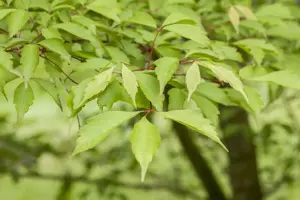
The deciduous leaves of the Common pear 'Köstliche von Charneux' are medium green, ovate, glossy, alternate. They are about 4 - 8 cm in size. Common pear 'Köstliche von Charneux' is bright orange-yellow in autumn.
Bark
Furrowed bark.
Spread
Europe to western Asia.
Frost hardiness
The Common pear 'Köstliche von Charneux' has good frost hardiness.
Growth
Cone-shaped, upright, branched.
Water
Water regularly and allow the soil to dry out in the meantime.
Pruning
Pruning, ideally from January to February, is advisable for this plant.
Location
Preferred location in a sunny to semi-shady position.
Soil
Pyrus communis 'Köstliche von Charneux' prefers nutrient-rich, sufficiently moist soil.
Planting time
Container plants can be planted all year round, except when the ground is frozen and in summer heat (over 30°C).
Tasks
- Fertilise: In the period from March to April
- Watering: In the period from May to September
- Pruning: In the period from January to February.
Care
- Cut and saw wounds as well as broken branches should be treated with a wound sealant as soon as possible to prevent pathogens from entering the plant.
- Fruit trees planted in spring must be watered generously throughout the summer. Well-rooted plants only require additional water in extremely dry conditions.
Fertiliser varieties
This plant is not self-fertile and needs support to bear fruit. The following plants are recommended as good pollinator varieties:
- Pyrus communis 'Gellerts Butterbirne'
- Pyrus communis 'Gute Luise'
- Pyrus communis 'Williams Christ'.
Flower
Pyrus communis 'Köstliche von Charneux' forms white flowers arranged in corymbs from April.
Fruit
Pyrus communis 'Köstliche von Charneux' forms yellow-green, oval fruits.
Disease resistance
The following diseases must be observed with Pyrus communis 'Köstliche von Charneux':
- Pear leaf rust: susceptible variety
- Pear leaf sucker: susceptible variety.
Use
Bee pasture, fresh consumption, juice, dessert
Root
Pyrus communis 'Köstliche von Charneux' is a deep-rooting plant.
- Article number19
-
EAN codePYCCHARN-80100C3SPIL
- Latin namePyrus c. 'Charneux'
- catalogLandscape shop