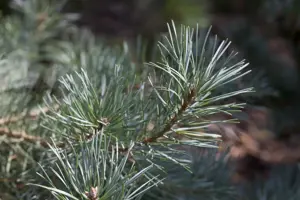
Syringa meyeri 'Palibin' - 30-40 CM C4
Syringa meyeri 'Palibin' - 30-40 CM C4
Description
The Lilac 'Palibin' (Syringa meyeri) is a round, bushy, dense small shrub that produces lilac-coloured flowers arranged in panicles with a strong fragrance. They appear from May to June. These produce brown fruits. They exude a strong fragrance. The Lilac 'Palibin' also has egg-shaped, dark green leaves. Its bark is grey-brown and smooth. In a sunny location with well-drained, nutrient-rich soil, it usually reaches a height of approx. 1.2 metres and grows to a width of approx. 1.2 metres.
Synonym
Synonyms (botanical): Syringa microphylla 'Minor', Syringa palibiana.
Bulletpoints
* Suitable for flowering hedges
* the blossoms are highly favoured by bees, bumblebees and hoverflies
* cut flower
* strongly scented flowers
* deer-resistant, heat-tolerant, drought-resistant, resistant to urban climates, cannot be built over
Leaves
The deciduous leaves of the Lilac 'Palibin's are dark green, ovate, wavy. They are about 3 - 5 cm in size.
Bark
Grey-brown, smooth bark makes this plant an eye-catcher in any garden.
Spread
China.
Frost hardiness
The Lilac 'Palibin' has good frost hardiness.
Growth
Lilac 'Palibin' is a round, bushy and densely growing small shrub with an opaque crown. It usually reaches a height of 1 - 1.2 m and is approx. 1 - 1.2 m wide. Slow-growing. Usually grows 5 - 20 cm per year.
Water
The plant has a medium water requirement.
Location
Preferred location in a sunny position.
Soil
Normal soil.
Planting time
Container plants can be planted all year round, except when the ground is frozen and in summer heat (over 30°C).
Planting partner
The Lilac 'Palibin' sets beautiful accents together with:
Mother-of-pearl bush, Philadelphus.
Tasks
- Mulching: In the period from March to April
- Fertilise: In the period from March to April
- Watering: In the period from May to September
- Pruning: In the period from June to July.
Care
- A slow-release fertiliser can be used in spring. This releases the nutrients slowly and continuously so that the plant is evenly supplied over a longer period of time.
- Lilacs flower on biennial wood, so the plant should be thinned out after flowering or plants that have grown too large should be pruned.
Flower
The lilac-coloured flowers of the Lilac 'Palibin' appear in panicles from May to June. These are strongly scented.
Use
Pruning, solitary, bee pasture, hedge
- Article number50
-
EAN codeSYMPALIB-2030040C4
- Latin nameSyringa meyeri 'Palibin'
- catalogLandscape shop